




Resource Flow Analysis



Please select an analysis tool


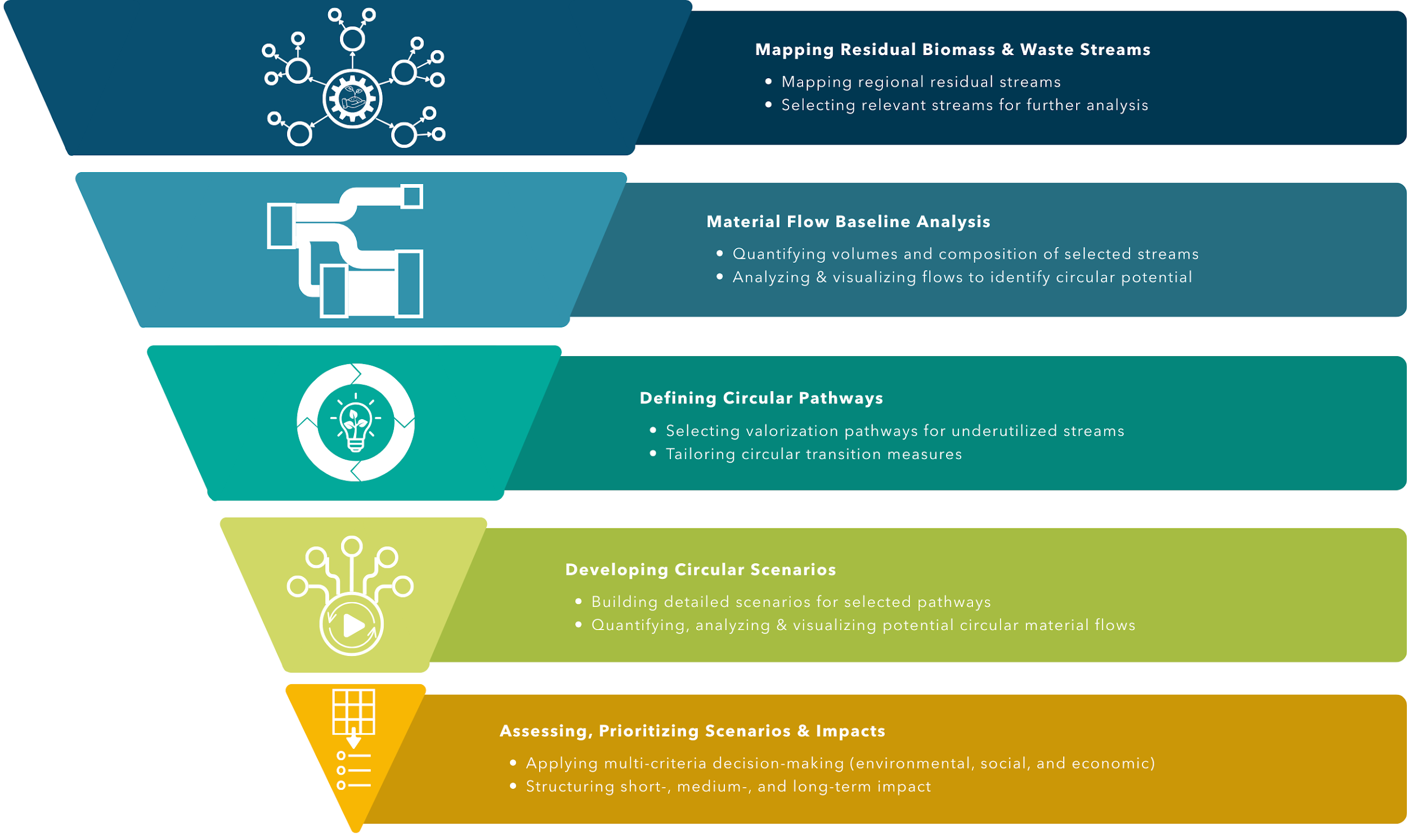
In our analysis we combine several analytical and participatory approaches: (i) Mind-Mapping Resource Flows – Identifying local residue streams and mapping potential conversion routes, (ii) Material Flow Analysis (MFA) – Quantifying inputs, outputs, and resource balances for selected pathways, (iii) Scenario Visualization with Sankey Diagrams – Creating clear, graphical representations of resource flows and efficiencies, and (iv) Multi-Criteria Decision Analysis (MCDA) – Comparing pathways based on economic, ecological and social parameters. These methods are applied in co-creation workshops with regional actors to ensure solutions reflect local realities. The focus in Pongau is on sewage sludge valorization. Further examples, with other resource flows, are showcased in the section “Best Practices”, demonstrating the broader potential of circular bioeconomy strategies.
MFA - Material Flow Analysis
The analysis begins with a Material Flow Analysis (MFA) of the status quo of regional resource flows, providing the basis for understanding material composition and identifying circular potential. Alternative valorisation pathways, defined through co-creation activities with regional stakeholders, are then also analysed through a detailed MFA. To facilitate interpretation, the quantified flows are visualised using Sankey diagrams, where the width of each arrow represents the magnitude of the resource flow. These visualisations help to better understand resource pathways and compare alternative circular bioeconomy scenarios. The results provide the analytical basis for assessing circular valorisation opportunities.
MCDA - Multi-Criteria Decision Analysis
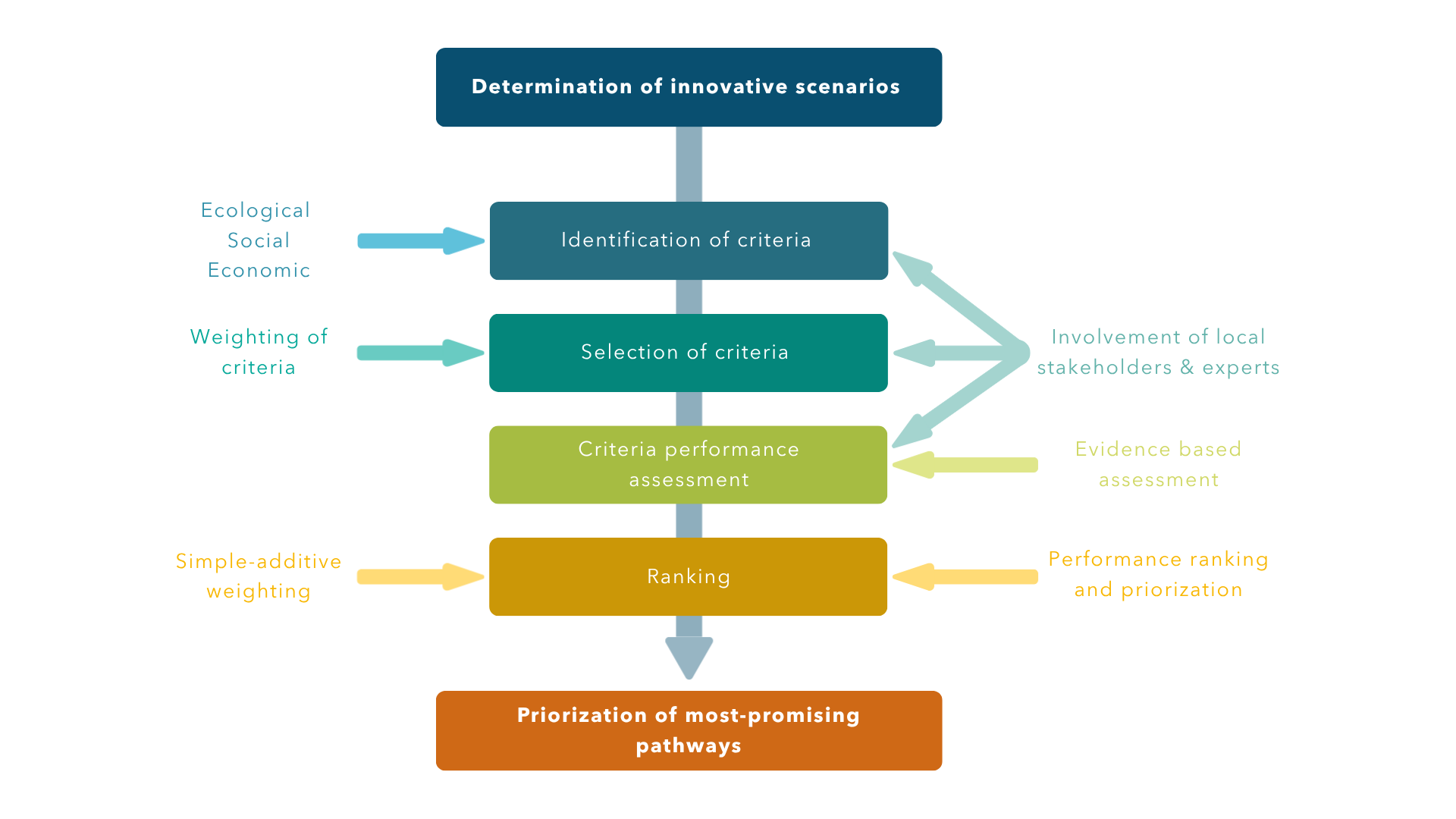
In the next stage, a Multi-criteria Decision Analysis (MCDA) is applied to assess the selected scenarios based on key environmental, social and economic criteria. These criteria are identified together with regional experts to ensure relevance to local conditions and decision needs. The evaluation combines qualitative expert judgement with quantitative inputs from literature and project data. By going beyond a simple cost-benefit perspective, the MCDA captures the broader real-world impacts of all scenarios and supports more robust and transparent decision-making.